
Your Core Questions Answered Before You Pack
Planning a trip to China often starts with two names: Beijing and Xi’an. These two cities form the backbone of any first-time visitor’s journey, capturing both the imperial grandeur of ancient China and the spiritual depth of its early dynasties. You likely want to see the Great Wall, the Forbidden City, and the Terracotta Warriors without wasting time or money. This itinerary focuses on what matters most: seeing the iconic sites efficiently, eating well, and avoiding common tourist traps.

How Many Days Do You Really Need for Beijing and Xi’an Together
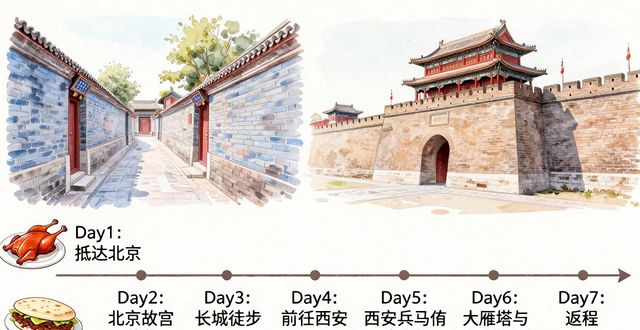
Five to seven days is the sweet spot for a comfortable trip that covers the essentials without burning you out. With five days, you rush through each city, but with seven, you get breathing room. I recommend seven days total: four full days in Beijing and two full days in Xi’an, plus one travel day between them. That gives you enough time to visit the Great Wall at Mutianyu, explore the Forbidden City and Temple of Heaven, walk through the Summer Palace, and then fly or take a high-speed train to Xi’an for the Terracotta Army, the Ancient City Wall, and the Muslim Quarter. The high-speed train takes about four and a half hours and is a comfortable way to see the countryside.
Is a Guided Tour Better Than Going Solo in These Two Cities
For Beijing, a guided tour helps you skip long ticket lines and understand the complex history of the Forbidden City and the Great Wall. Solo travelers can manage with apps and maps, but the sheer scale of sites like the Summer Palace can feel overwhelming without context. In Xi’an, the Terracotta Warriors are best seen with a guide who explains the excavation history and the emperor’s obsession with immortality. However, the Muslim Quarter and the City Wall are easy to explore on your own. A hybrid approach works well: book a guide for the two major historical sites, and go independent for the rest. This saves money while still getting deep insights where they matter most.
What Should You Eat and Where to Stay Conveniently
In Beijing, stay near the Dongzhimen or Qianmen area for easy subway access to major sites. Don’t miss Peking duck at a local restaurant like Sijie Minfu, and try jianbing from a street stall for breakfast. In Xi’an, the Muslim Quarter is where you’ll find the best street food: lamb skewers, biangbiang noodles, and pita bread soaked in lamb soup. Stay near the Bell Tower or South Gate for walking access to the night market and the City Wall. Budget 100 to 150 USD per night for a decent mid-range hotel in either city, and expect meals to cost 5 to 15 USD per person for local food.
Once you have this framework, your trip becomes less about logistics and more about soaking in the history. The Great Wall at sunrise,the silent rows of Terracotta Warriors, the taste of hand-pulled noodles in a narrow alley—these moments define the experience. Plan ahead, but leave room for spontaneity.