
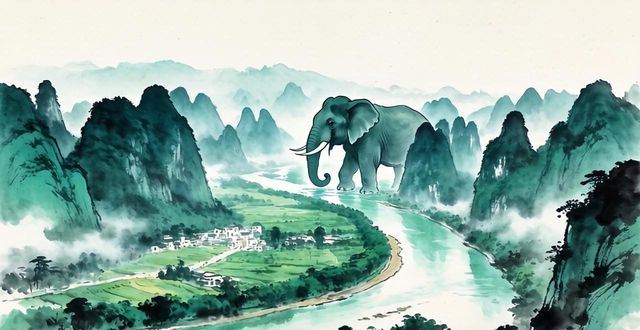
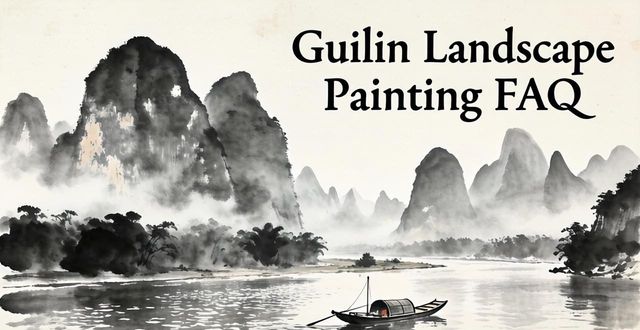
Guilin landscape painting is one of China’s most celebrated art forms, capturing the dramatic karst mountains, winding Li River, and ethereal mist that define this region. Unlike Western landscape art that often emphasizes realistic detail and perspective, Guilin painting focuses on emotional resonance and spiritual harmony. For foreign travelers and art lovers, understanding these works opens a window into traditional Chinese aesthetics, where brushstrokes and blank space carry as much meaning as the visible scenery. This guide answers the most common questions about Guilin landscape painting, from its unique features to where you can see the best examples.
What makes Guilin landscape painting unique?
The first thing you notice is the interplay between solid mountains and flowing mist. Artists use soft, wet brush techniques to create gradients that suggest fog dissolving into rock. Unlike realistic depictions, Guilin painting often leaves large areas of unmarked rice paper, representing the sky or water. This “negative space” invites viewers to complete the scene in their imagination. Another hallmark is the use of “cun” texture strokes – layered dry-brush marks that give cliffs a rough, weathered feel. These techniques evolved over centuries, with masters like Mi Fu and later Li Keran refining the style.

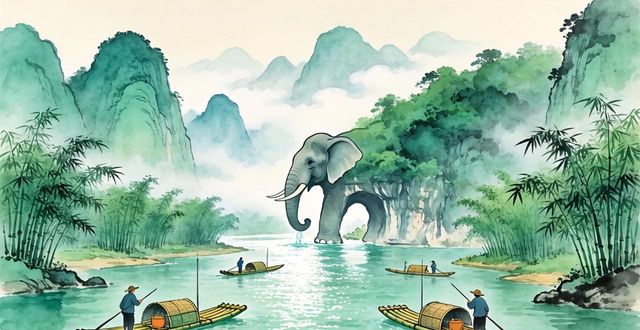
Because Guilin’s landscape changes with weather and seasons, no two paintings look exactly alike. A skilled artist captures not just the shape of Elephant Trunk Hill or the peaks along the Li River, but the mood of a rainy morning or a sunset glow. You’ll also notice tiny figures – a fisherman on a raft or a pavilion half-hidden among trees – which emphasize the scale of nature. This human element reflects the Taoist idea that people are small guests in a vast, living world. For collectors, these subtle details are what distinguish a genuine Guilin painting from a generic landscape.
How to identify authentic Guilin painting?
Authentic Guilin landscape painting follows strict traditional materials and methods. First, look for xuan paper (rice paper) with a slightly rough texture – modern prints on glossy paper are usually reproductions. Genuine works use ink sticks ground from pine soot and mineral pigments like azurite for blue-green accents. The brushwork should show variation in pressure: thick, dark strokes for foreground trees and lighter, broken lines for distant peaks. Many fakes have uniform ink density,lacking the lively “flying white” effect where dry brush skips across paper.
Another clue is the seal and signature. Traditional artists stamp their work with red cinnabar seals, often including a personal motto or studio name. Check if the calligraphy matches the artist’s known style. For example, the modern master Li Keran used bold, heavy outlines and small red seals near the edge. Also, authentic Guilin paintings often include a poem or inscription in elegant running script. If you’re buying, ask for a certificate from a reputable gallery. Avoid pieces that look overly perfect or symmetrical – real landscape art embraces natural imperfection, just like the mountains themselves.
Why are misty mountains so important?
Mist is not just weather in Guilin painting; it is a philosophical tool. In traditional Chinese thought, clarity represents the material world, while mist symbolizes the unknown, the spiritual, and the flow of qi (life energy). By shrouding parts of the mountain, the artist creates depth without linear perspective. The eye moves from solid rocks in the foreground to fading shapes in the background, mimicking how we perceive distance in real foggy mornings. This technique is called “yun shan” (cloud mountains) and it dates back to the Southern Song Dynasty.
Moreover, mist allows multiple viewpoints within one painting. You might see a mountain peak from below, a river bend from above, and a distant village through a break in the clouds – all in the same scroll. This rejects the single vanishing point of Western art, giving the viewer a wandering, dreamlike experience. For the Chinese literati, painting misty mountains was a form of meditation. It expressed the ideal of reclusion: escaping official duties to live simply among nature’s mysteries. When you look at such a painting, you’re not just seeing Guilin – you’re stepping into a state of mind.
Where to see best Guilin landscape works?
The finest collection outside China is at the Metropolitan Museum of Art in New York, which holds several Song and Ming dynasty scrolls depicting the Guilin region. For a more immersive experience, visit the Guilin Art Museum in Guangxi – their permanent collection includes works by modern masters like Huang Binhong and Bai Xueshi. Another hidden gem is the Yangshuo Calligraphy and Painting Academy, where local artists demonstrate traditional techniques and sell original pieces. If you’re traveling along the Li River, stop at the Xingping Fishing Village; many painters set up easels there to capture the same view seen on the back of China’s 20-yuan note.
For digital viewing, the Palace Museum in Taipei offers high-resolution images of ancient Guilin paintings on their website. Auction houses like Christie’s and Sotheby’s occasionally feature 20th-century Guilin works in their Chinese painting sales. Remember that many great pieces remain in private collections or small temple halls. When visiting Guilin’s Reed Flute Cave or Fubo Hill, look for stone carvings and wall paintings left by scholar-officials centuries ago. These less touristy spots often hold surprises that no museum can replicate.
Now, I’d love to hear from you: Have you ever seen a Guilin landscape painting in person, and what feeling did it give you? Share your thoughts in the comments, hit like if you enjoyed this guide, and pass it along to fellow art lovers.