
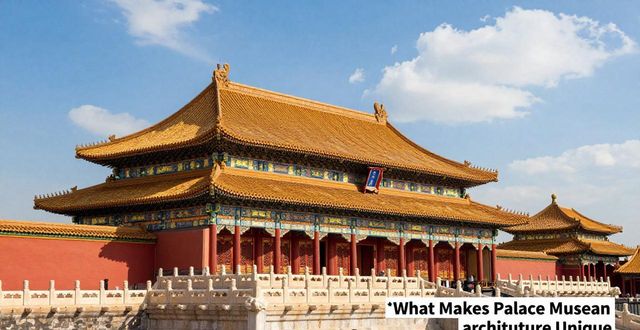
For international visitors, the Palace Museum—often called the Forbidden City—is far more than a treasure house of Chinese art. Its sprawling palace complex represents the pinnacle of traditional Chinese wooden architecture, blending cosmology, strict social hierarchy, and ingenious engineering. Developed between 1406 and 1420 under the Ming Dynasty, this 720,000-square-meter masterpiece has survived fires, wars, and earthquakes for over 600 years. Understanding its architecture unlocks not just aesthetic appreciation but also a deep respect for the builders’ wisdom. Let me walk you through the most intriguing features that make this UNESCO World Heritage site an enduring architectural marvel.
Why the north-south axis matters

Foreign visitors often notice the perfect symmetry of the Forbidden City. That’s because every major hall, gate, and courtyard aligns along a single north-south central axis. In traditional Chinese thought, the emperor’s throne must face south—the direction of warmth and prosperity—while the north represented a mysterious, powerful energy. This axial layout also served a practical purpose: it reinforced hierarchical order. The most important buildings, like the Hall of Supreme Harmony, sit exactly at the center, while lesser structures move outward. If you stand at the Meridian Gate, you can look all the way through to the Gate of Divine Might and feel the deliberate, powerful sense of direction. No other ancient palace complex in the world applies this axis concept so strictly across such a massive area.
What do rooftop animals symbolize
Look up at any roof inside the Palace Museum, and you’ll notice a row of small mythical creatures sitting on the eaves. These are not just decorations—they carry deep symbolic protection. The number of rooftop animals tells you a building’s rank. The Hall of Supreme Harmony, the highest-ranked hall, boasts ten statuettes: an immortal riding a phoenix followed by a dragon, phoenix, lion, heavenly horse, sea horse, and others. Lower-ranking halls have fewer, usually odd numbers from three to nine. Each animal wards off specific disasters: the dragon controls rain, the lion scares away evil spirits, and the fish prevents fire. For ancient builders, these terracotta guardians combined spiritual belief with practical need, creating a visual language understandable to every subject who entered the palace.
How did wooden structures survive centuries
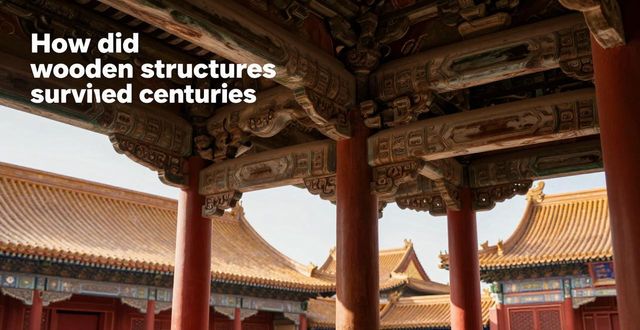
Many visitors ask me, “How can a wood palace last 600 years without metal nails?” The secret lies in a unique bracket system called dougong (斗拱). Interlocking wooden brackets fit together like a 3D puzzle, allowing walls to be non-load-bearing. When earthquakes shake Beijing, the dougong blocks slide and rub together, dissipating seismic energy rather than cracking. Tests show that a scaled version of a Forbidden City hall can survive a magnitude 10.1 quake. Moreover, the builders used nanmu wood, a slow-growing cypress naturally resistant to rot and insects. They also avoided embedded columns in soil; instead, stone bases elevate each pillar, preventing moisture damage. This flexible, modular design meant damaged parts could be replaced without collapsing the whole structure—a genius concept only fully appreciated by modern earthquake engineers.
Why red walls and yellow glazed tiles
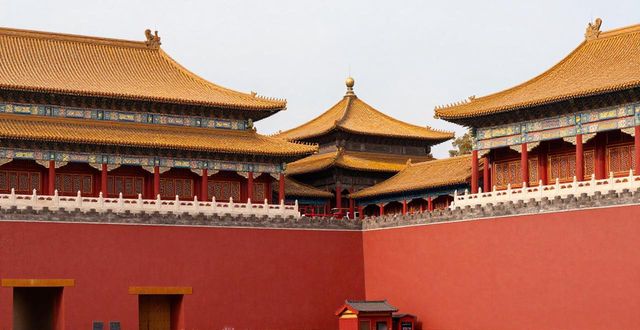
Step into any courtyard, and you’re surrounded by two dominant colors: bright red walls and golden-yellow roof tiles. Red symbolized happiness, nobility, and the sun’s life-giving energy, while yellow was the exclusive color of the emperor (the Son of Heaven). In Chinese five-element theory, yellow corresponds to earth, the element at the center of the universe. The glazed tiles are more than symbolic: the high-temperature firing makes them waterproof, and their smooth curves help rain run off quickly. Under the tiles, you’ll find intricate caisson ceilings (zaojing) painted with dragons and clouds. As for the floor, those shiny “golden bricks” (jinzhuan) are actually dark clay from Suzhou, tapped to produce a metallic ring. Even today, no modern coating matches their natural sheen and durability.
So next time you walk through the Palace Museum, look beyond the crowds and notice how every beam, color, and roof curve tells a story of power, nature, and human cleverness. Now here’s a question for you: If you could add one modern eco-friendly feature (like solar panels or rainwater recycling) to the Forbidden City without changing its historic appearance, what would it be? Share your idea in the comments—and don’t forget to like and pass this article to fellow architecture lovers.