
China’s visa policy in 2026 represents a significant and sustained effort to facilitate international travel, promote people-to-people exchanges, and signal the country’s commitment to high-level opening-up. Building upon a series of facilitative measures introduced since late 2023, the policy framework for 2026 is characterized by an expanded “visa-free circle,” greatly relaxed transit rules, and streamlined application procedures. This comprehensive overview details the key components of China’s 2026 visa policy.
- Unilateral Visa-Free Policy for Ordinary Passport Holders
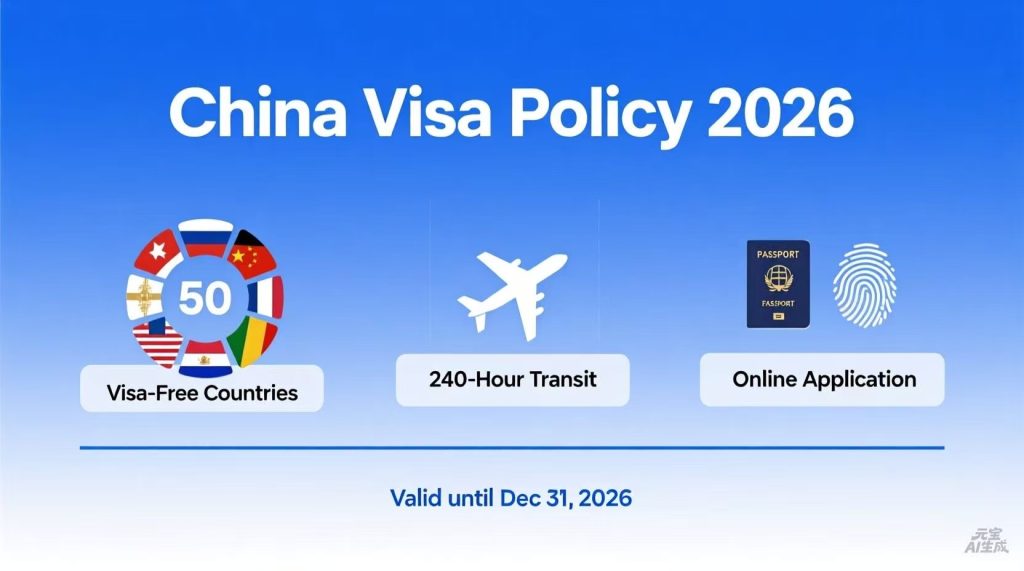
The cornerstone of China’s 2026 entry policy is the unilateral visa-free arrangement for nationals of 50 specific countries. This policy allows ordinary passport holders from these nations to enter China for short-term stays without obtaining a visa beforehand.
Eligible Countries: The list, updated as of March 5, 2026, encompasses 50 countries across four regions :
- Europe (35 countries): Andorra, Austria, Belgium, Bulgaria, Croatia, Cyprus, Denmark, Estonia, Finland, France, Germany, Greece, Hungary, Iceland, Ireland, Italy, Latvia, Liechtenstein, Luxembourg, Malta, Monaco, Montenegro, Netherlands, North Macedonia, Norway, Poland, Portugal, Romania, Russian Federation, Slovakia, Slovenia, Spain, Sweden, Switzerland, United Kingdom.
- Oceania (2 countries): Australia, New Zealand.
- Asia (7 countries): Bahrain, Brunei Darussalam, Japan, Kuwait, Oman, Republic of Korea, Saudi Arabia.
- Americas (6 countries): Argentina, Brazil, Canada, Chile, Peru, Uruguay.
Validity Periods: The policy’s duration varies slightly by country:
- The arrangement for Brunei has no specified expiration date .
- The visa-free policy for Russia remains effective until September 14, 2026 .
- For the remaining 48 countries, including the newly added Canada and the United Kingdom, the policy is valid until December 31, 2026 .
Conditions and Permitted Activities: Travelers from these countries can enter China visa-free for purposes including business, tourism, visiting relatives or friends, cultural/sports exchanges, and transit. The maximum permitted stay is 30 days. The stay duration is calculated from 00:00 on the day following entry . It is important to note that activities such as work, study, or news reporting, which require specific approval, are not covered under this visa-free policy and necessitate the appropriate visa.
- Dramatically Relaxed Transit-Without-Visa (TWOV) Policy
In a major policy shift announced in December 2025, China significantly optimized its Transit-Without-Visa program, making it one of the most generous and flexible in the world .
Key Upgrades:
- Extended Stay Duration: The maximum permitted stay under the TWOV policy has been unified and extended from the previous 72 or 144 hours to 240 hours (10 days) .
- Increased Number of Ports: The number of ports where foreign nationals can enter and exit under this policy has been expanded from 39 to 60 ports across China .
- Broader Geographic Coverage: The policy now applies in 24 provincial-level regions (provinces, municipalities, and autonomous regions), up from 19 . Newly added provinces include Shanxi, Jiangxi, Anhui, Guizhou, and Hainan .
- Cross-Provincial Travel Allowed: Most significantly, the policy now permits travel across provincial boundaries within the designated 24 regions. This means a traveler entering, for example, through Shanghai can legally travel to and stay in Jiangsu, Zhejiang, or Anhui within their 240-hour period, vastly increasing itinerary flexibility .
Eligibility and Requirements: This policy applies to nationals from 55 eligible countries (including the UK, US, Canada, Russia, Brazil, and most EU nations) . To qualify, travelers must:
- Hold a passport or valid international travel document with at least three months of validity.
- Have confirmed onward tickets (with date and seat) to a third country or region, departing within 240 hours of entry into China.
- Enter and exit through one of the designated 60 ports.
Designated Regions and Ports: The 24 regions where the 240-hour TWOV policy applies are: Beijing, Tianjin, Hebei, Shanxi, Liaoning, Shanghai, Jiangsu, Zhejiang, Anhui, Fujian, Jiangxi, Shandong, Henan, Hubei, Hunan, Guangdong, Guangxi, Hainan, Chongqing, Sichuan, Guizhou, Yunnan, Shaanxi, and Heilongjiang . Activity is permitted throughout the entire administrative area for most, though some regions like Heilongjiang, Sichuan, and Yunnan have specific city-level designations . Major air, land, and sea ports in these regions are included in the list of 60 eligible ports.
- Additional Facilitation Measures for All Travelers
Beyond visa-free arrangements, China has extended several key administrative measures to lower barriers and simplify the process for those who do need a visa.
- Fingerprint Collection Exemption: To reduce the need for in-person visits, the mandatory fingerprint collection requirement for short-term visa applicants (applying for stays of 180 days or less) has been suspended until December 31, 2026 . This exemption applies globally at all Chinese embassies and consulates.
- Visa Fee Reduction: The policy of reduced visa application fees, first introduced in late 2023, has also been extended through December 31, 2026 . This keeps the official visa fee at a fraction of its pre-2023 level, though service charges from visa application centers may still apply.
- Online Entry Card (“China Travel Card”): Since November 20, 2025, foreign travelers have been able to complete their entry card information online before arrival via the National Immigration Administration’s (NIA) website, mobile app, or WeChat/Alipay mini-programs . This digital option streamlines the arrival process at border inspection points.
- Streamlined Online Visa Application Process
For travelers from non-visa-free countries or those needing longer stays, China has fully implemented a modernized online application system.
The primary platform is the China Visa Application Service Center website (www.visaforchina.cn(www.visaforchina.cn)) . Applicants can:
- Register an account and select their local application center (e.g., Toronto, Manila).
- Complete the application form online in nine sections covering personal details, travel plans, and background information.
- Upload digital copies of all required supporting documents (passport bio-page, photo, invitation letters, etc.).
- Submit the application online for preliminary review, which typically takes 3-5 business days .
- Upon receiving an “Online review completed” status, applicants or their agents must visit the visa center in person to submit the original passport, the printed application form, and pay the fee . The final visa decision rests with the consular officer.
This online system, now rolled out globally, significantly reduces errors and preparation time compared to paper-based applications.
- Policy Context and Strategic Objectives
The 2026 visa policy is not an isolated set of rules but a strategic component of China’s broader economic and diplomatic agenda. Officials have explicitly linked these measures to implementing the guiding principles of the Communist Party of China Central Committee, aiming to “expand high-level opening-up to the world, and continuously facilitate personnel exchanges” .
The relaxation is also a direct response to market demand. Statistics showed that over 80% of foreign tourists on the previous 144-hour TWOV scheme stayed until nearly the last moment of their permitted time, indicating a strong desire for longer, more immersive travel experiences in China . The policy upgrade to 240 hours with cross-provincial travel directly addresses this demand.
The results have been tangible. In the third quarter of 2025 alone, foreign nationals made 7.246 million visits to China under its visa-free policies, a 48.3% year-on-year increase, accounting for 72.2% of all entries by foreigners . The NIA’s goal is to reach 50 million inbound foreign visitors, and these policies are crucial drivers toward that target .
Conclusion
China’s 2026 visa policy framework is designed to be welcoming, convenient, and flexible. It offers multiple pathways for entry: a straightforward 30-day visa-free option for passport holders from 50 nations, a generous 10-day transit window for travelers from 55 countries with onward tickets, and a streamlined online application process for all others. Coupled with fee reductions and biometric exemptions, these measures collectively lower the cost and complexity of visiting China. Travelers are advised to always verify the latest information with the official Chinese Ministry of Foreign Affairs website or their local Chinese embassy/consulate before finalizing travel plans, as policies can be subject to updates. Nonetheless, the current landscape for 2026 clearly demonstrates China’s active push to integrate more deeply with global travel and business networks.