
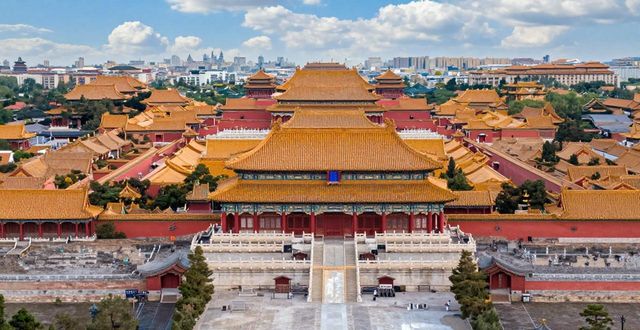
The Palace Museum, also known as the Forbidden City, is not just a treasure house of Chinese art and history; it is a living textbook of ancient Chinese architecture. Built between 1406 and 1420, this sprawling complex of over 980 buildings represents the pinnacle of traditional Chinese palatial design. For foreign visitors, understanding its architecture unlocks a deeper appreciation of Chinese cosmology, social order, and engineering brilliance. In this guide, we’ll explore the most fascinating features of the Palace Museum’s architecture, from its symmetrical layout to its hidden earthquake-proof secrets.
The Symmetrical Layout and Cosmic Symbolism
The most striking feature of Palace Museum architecture is its strict north-south axis. Every major hall, gate, and throne sits along this invisible line, with lesser buildings mirroring each other on the east and west. This layout reflects the ancient Chinese belief that the emperor, as the Son of Heaven, must live in perfect harmony with the cosmos. The north, associated with the element of water and winter, was considered the most powerful direction, so the emperor’s throne faces south to receive warmth and light.

This axial symmetry also reinforced social hierarchy. The three Great Halls—Taihe, Zhonghe, and Baohe—stand on a three-tiered white marble terrace, symbolizing the emperor’s supreme authority. Lesser officials were relegated to smaller courtyards farther from the center. Even the placement of gates, bridges, and pillars followed strict rules. For example, the five marble bridges over the Golden Water River represent the five Confucian virtues. Walking through the complex, you literally step through a physical map of ancient Chinese political and spiritual order.
Roof Styles and Colorful Decoration
You’ll quickly notice that not all roofs in the Palace Museum are the same. The most important halls, like the Hall of Supreme Harmony, use the “double-eave, hip-and-gable” roof (chongyan wudian), reserved only for the highest imperial structures. Lesser buildings have simpler “single-eave, gable-and-hip” or “hard” roofs. The bright yellow glazed tiles covering most roofs were exclusive to the emperor, because yellow symbolized the earth’s center and imperial power. Green tiles were used for princes’ residences, representing wood and growth, while black tiles marked libraries, as black symbolized water to protect against fire.
Look closer,and you’ll see a menagerie of mythical beasts sitting on the roof ridges. The number of these “roof guardians” indicates the building’s status: the Hall of Supreme Harmony has ten, the most of any structure in China. The lead figure is a phoenix-riding immortal, followed by dragons, lions, and sea horses. Besides roofs, the intricate dougong brackets—wooden puzzle pieces that support eaves without nails—are both decorative and structural. These rainbow-like brackets are a signature of Palace Museum architecture, showcasing how beauty and function blend seamlessly.
Earthquake Resistance Without Nails
One of the most astonishing secrets of Palace Museum architecture is its ability to withstand massive earthquakes. All major halls are built using a “post-and-lintel” system with dougong brackets, but no iron nails or glue. Instead, interlocking wooden joints allow the entire structure to flex like a giant shock absorber. When seismic waves hit, the walls may crack or even collapse outward, but the wooden frame sways and returns to its original position. Modern engineers tested a 1:5 scale replica on a shaking table and found it survived a simulated magnitude 10 earthquake without collapsing.
This resilience comes from three design choices. First, the dougong brackets act as friction dampers, dissipating energy through their layered blocks. Second, heavy roofs with thick tiles add downward pressure, keeping the frame stable. Third, the columns are not deeply embedded in the ground; they rest on stone bases, allowing them to slide slightly. This “floating column” technique prevents bending stress from snapping the wood. Considering the Forbidden City lies in a seismically active region, its survival of over 500 earthquakes—including a massive one in 1679 that leveled nearby towns—proves the genius of its anonymous architects.
The Hidden Drainage System
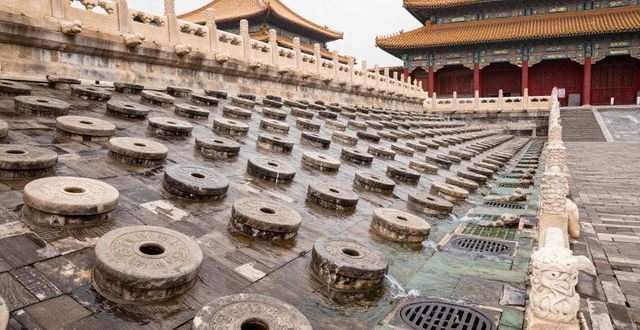
Palace Museum architecture also includes an ingenious underground drainage system that still works perfectly after 600 years. The complex is built on a gentle slope from north to south, so rainwater naturally flows toward the southern gate. Thousands of hidden stone drains, shaped like coins or animal mouths, channel water into a main underground canal that empties into the Golden Water River. During heavy downpours, you can see water spurting from dragon-headed drains carved into the marble terraces—a dramatic and functional spectacle.
This system was tested in July 2012, when Beijing received the heaviest rainfall in 60 years. While many streets flooded, the Forbidden City remained mostly dry. The secret lies in the network’s massive cross-section and the smooth, interlocking stone channels that rarely clog. Ancient craftsmen even carved curved channels to slow water flow and prevent erosion. For modern city planners, this 15th-century drainage is a humbling lesson in sustainable design. Next time you visit on a rainy day, watch the ground—you’ll witness a silent, elegant dance of water that has worked for centuries.
Which feature of the Palace Museum’s architecture surprises you the most—the earthquake-proof wooden joints, the symbolic roof colors, or the ancient drainage system? Share your thoughts in the comments below, and don’t forget to like and share this article with fellow architecture lovers!