

In 1974, a group of farmers digging a well in Lintong, Shaanxi Province, struck something hard beneath the loess soil. What they unearthed would reshape our understanding of ancient Chinese military art. The Terracotta Army discovery remains one of the twentieth century’s most consequential archaeological finds, turning a quiet rural stretch into a global pilgrimage site.
How did the Terracotta Army discovery happen

The farmers working near the village of Xiyang were following a routine agricultural practice. They had been digging for water when their shovels hit a kiln-fired shard. Within weeks,archaeologists from the local museum arrived and began systematic excavation. The figures were arranged in vast underground chambers, still painted in their original polychrome finishes, frozen in battle formation as though awaiting a command from a dead emperor.
The first pit alone held nearly two thousand soldiers and a dozen chariots, all facing east toward the capital. The layout mirrors a standing army on a march, not a burial mound. Researchers still argue over whether the remaining pits held cavalry or diplomatic entourages.
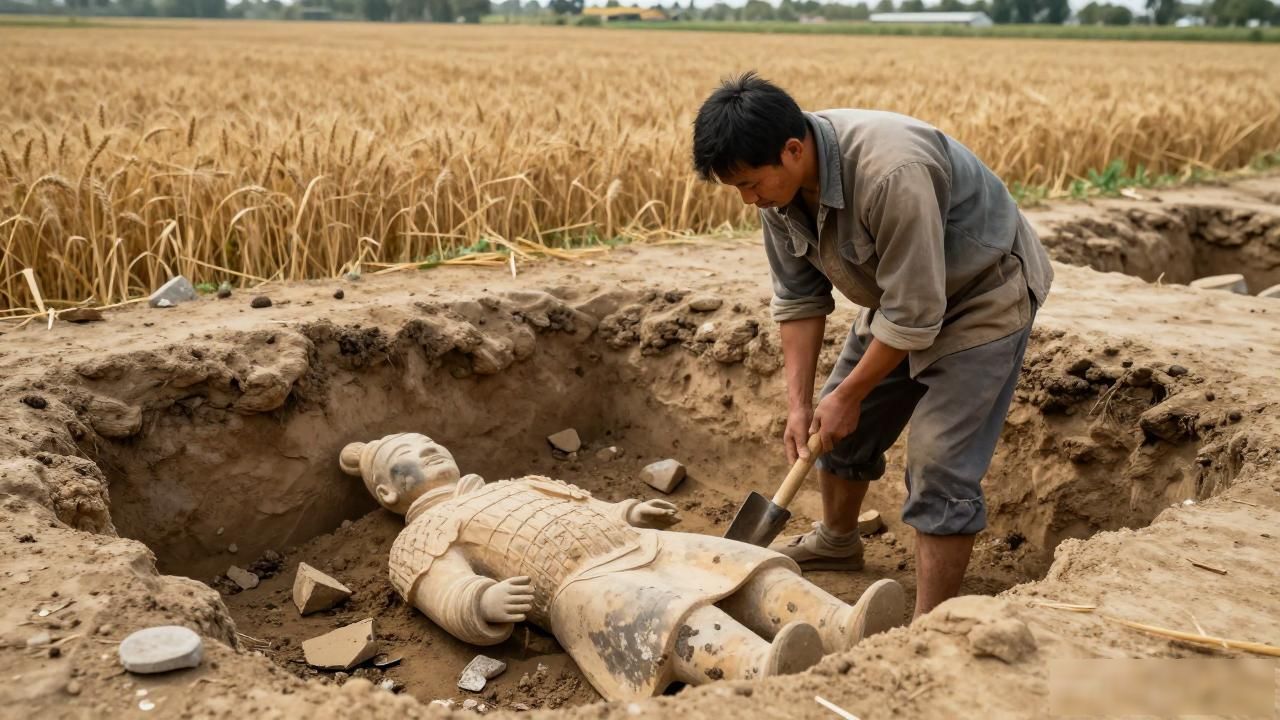
What made the Terracotta Army discovery possible
The army survived two millennia not by luck but by deliberate engineering. Each pit was sealed with layered earth and capped with a timber roof of heavy crossbeams, designed so that any intruder breaking the outer wall would trigger a ceiling collapse. When warlord bands did exactly that in 207 CE, the roofs came down and shattered nearly every figure into ceramic shards. That destruction became, paradoxically, the preservation: fragments sank into the pit floors and were buried by soil deposits, shielded from every war that followed.
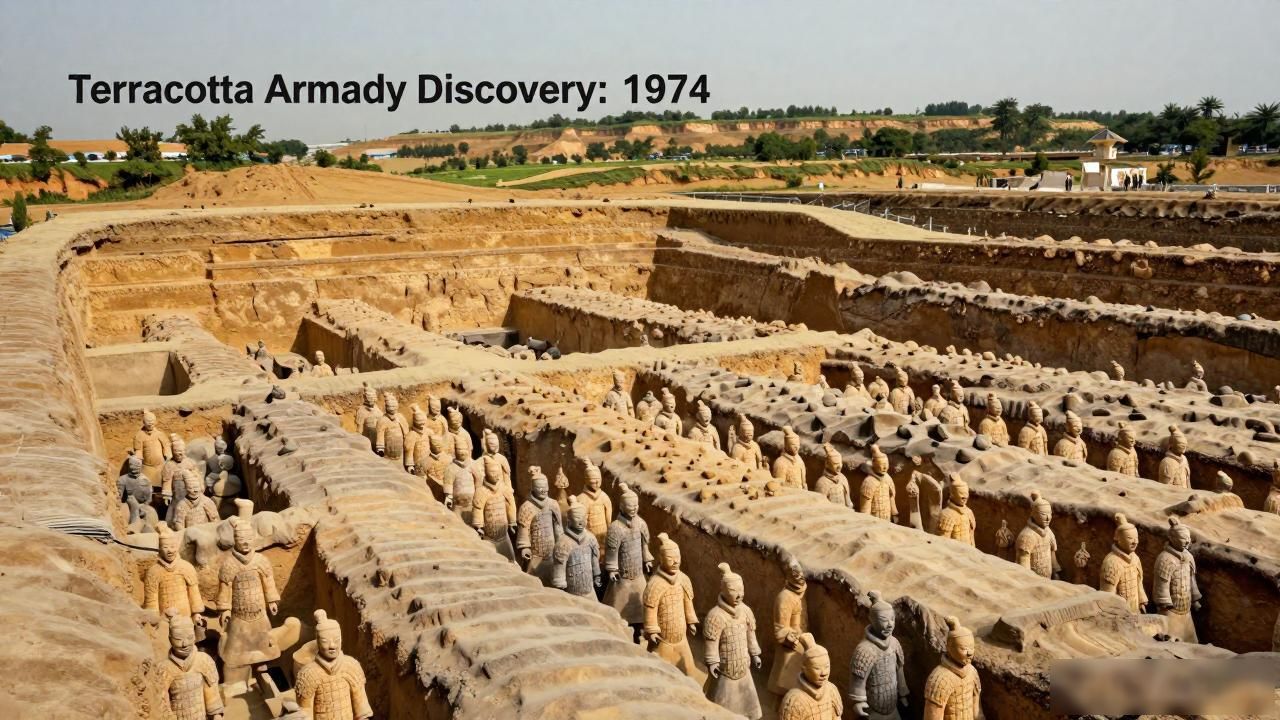
The loess plateau’s geology also played a quiet role. The dense, layered soil above the pits created a natural insulation blanket that kept humidity low and temperatures stable. Had the site sat in a wetter climate, the painted surfaces would have peeled within centuries. The combination of intentional engineering and favorable geology is what made a small-town farmers’ accident into the discovery the world now knows.
Standing in Pit One today, watching restoration crews carefully reassemble a broken general’s sandal, you feel the weight of time compressed into clay. The Terracotta Army discovery belongs to no single nation or era; it is a reminder that the ground beneath our feet still keeps secrets waiting for the right pair of hands.
Seeing restoration crews in Pit One painstakingly reassembling intricate details like a general’s sandal underscores that the discovery wasn’t a finished event in 1974, but an ongoing, generational effort of material reconstruction. It really brings home the idea that ancient military art survives as much through patient scientific conservancy as it did through deliberate ancient design.