
If you are planning a visit to China and want to skip the lengthy visa application process, the answer may already be waiting at one of China’s open seaports. In recent years, the Chinese government has steadily expanded its visa-free transit programs, making it easier for international travelers to step onto Chinese soil without obtaining a traditional visa beforehand. This guide will walk you through everything you need to know about boarding a ferry or cruise to China visa-free and how the system actually works in practice.
What seaports in China allow visa-free entry

China operates several seaports under its visa-free transit framework, and the list continues to grow as more coastal and river ports join the program. The most frequently used ones include Shanghai, Qingdao, Weihai, Lianyungang, Beihai,Fuzhou, Xiamen, and Shantou. Each of these ports sits within a designated visa-free zone, meaning you can arrive by sea and stay within that area for a limited period without a visa. It is important to verify that your point of entry is covered before booking any ferry or cruise, as not every port along China’s extensive coastline participates in the program.
The 144-hour visa-free transit policy is the star attraction for most travelers. Under this arrangement, citizens of qualifying countries can remain in a defined geographic zone for up to six full days after arriving at a participating seaport. The rules differ slightly depending on which port you use, so the exact zones matter a great deal. For example, arriving at Shanghai Port allows you to explore Shanghai and surrounding areas in Jiangsu and Zhejiang provinces during your 144-hour window. Arriving at Qingdao Port opens up Shandong province instead. Knowing which cities you can legally visit is the key to a smooth arrival.
How does the 144 hour visa free transit work at Chinese seaports
The mechanics behind the 144-hour visa-free transit are straightforward once you understand the requirements. You must hold a valid passport from an eligible country and possess a confirmed onward ticket to a third country or region within the 144-hour limit. This means you cannot simply use the transit pass to circle back to your home country; the ticket must point somewhere else entirely. Cruise passengers often find this arrangement quite convenient since their itinerary naturally includes multiple stops and an eventual departure to another destination.
When you arrive at the port, you will pass through immigration and receive a temporary permit that records your allowed stay duration. You must register with local authorities if you plan to stay in private accommodation, though hotels usually handle this automatically. Staying within the permitted zone is strictly enforced, so venturing outside the designated cities or provinces can lead to complications. Make sure your travel plans stay within the boundaries set by your port of entry, since border officers take these rules seriously.
Which nationalities can use China visa free seaports
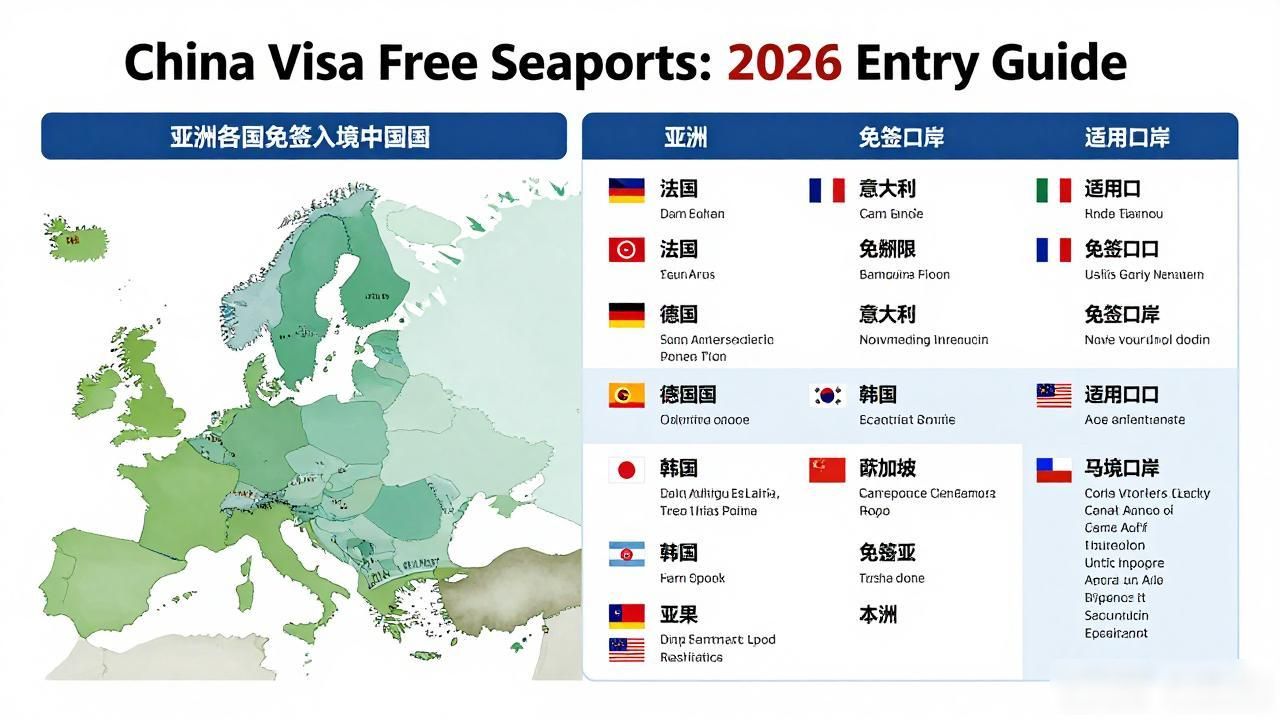
Eligibility depends largely on your passport, and the list of qualifying countries is reasonably broad. Citizens of most European nations, including Germany, France, Italy, Spain, the United Kingdom, and Russia, can take advantage of the visa-free transit system. Many Asian countries are also included, such as Japan, South Korea, Singapore, Malaysia, Thailand, and the Philippines. North American travelers from the United States and Canada are similarly covered. The full list includes over fifty countries, and China periodically adds more, so it is worth checking the latest official sources before you book your trip.
If your country is not on the eligible list, you will still need to apply for a traditional visa through a Chinese embassy or consulate. There are limited exceptions for certain cruise lines that operate under special arrangements, but these cases are rare and highly specific. Most travelers will find that sticking to the standard 144-hour transit option is the simplest path, provided they meet the nationality and ticket requirements. With careful planning and the right documentation, reaching China through a visa-free seaport can be a relaxed and hassle-free experience.